

Video Overlay Titlle
Video Overlay description
This site is intended only for Healthcare Professionals who are interested in the management of gastric cancer and/or gastro-oesophageal junction cancers.
I AM NOT A HEALTHCARE PROFESSIONAL BUT WOULD LIKE MORE INFORMATION ON GASTRIC/GASTRO-OESOPHAGEAL JUNCTION CANCERS
Why use CLDN18 antibodies for detecting CLDN18.2 in G/GEJ tumour samples?
CLDN18 antibodies can identify both CLDN18 isoforms— CLDN18.1 and CLDN18.2. But when evaluating G/GEJ tumour tissue, staining can be attributed to the presence of CLDN18.2 because2,3:
Sample preparation and preanalytics
Appropriate specimen handling and preparation are essential to ensure the accuracy of biomarker results.1
Takeshi Kuwata, MD, PhD

Guidelines recommend daily tissue processor maintenance per the manufacturer recommendations, and rigorous quality maintenance of processor fluids, including formalin pH/purity and water contamination of alcohols.1
Cold ischemic time should be limited to ≤60 minutes according to current guidelines.1
Guidelines provide recommendations regarding dimensions and duration involved in sample fixation.1

Tissue should be completely submerged in fixative
Ensure a fixative volume to tissue mass ratio of no less than 4:1, with an optimal ratio of 10:1
Paraffin should be melted at <60°C
Specimen containing sufficient tumour tissue for analysis

As part of stabilisation, tissue should be fixed in 10% neutral phosphate-buffered formalin (pH 7.0) for at least 6 hours and no longer than 24 to 36 hours
If the tissue has high fat content, fixation may require up to 48 hours
It is important to optimize pre-analytical variables to minimize staining artifacts, which can interfere with accurate scoring.
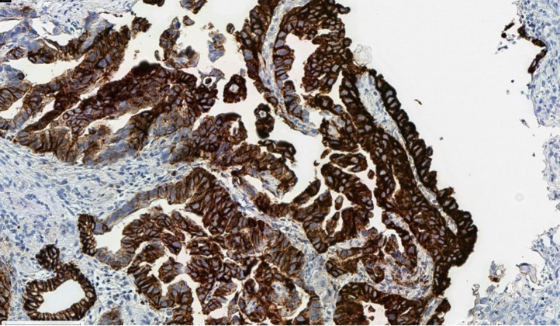
Cytoplasmic blushing due to suboptimal fixation, which can interfere with accurate membranous scoring.
Routinely processed, formalin-fixed, paraffin-embedded (FFPE) tissues are suitable for use with IHC testing
Specimens that are fine-needle aspirate (FNA), cytology specimens or metastatic bone lesion do not qualify for CLDN18 staining
Tissue sections can be cut at 3 µm-6 µm*
Before staining, the cut slides should be dried completely either at room temperature (air dried)
or by offline baking (baked in oven) at 60°C for 60 minutes*
To ensure integrity of specimens, storage areas should be:
Dry
Pest-free
Room temperature (18°C to 25°C)


A number of assays, antibodies, and platforms are available for the assessment of CLDN18.2 expression. Assays and antibodies include the VENTANA CLDN18 (43-14A) IVD Assay, the LSBio PathPlus™ CLDN18 Antibody, and the Recombinant Anti-Claudin 18 antibody (43-14A). Options for platforms include BenchMark ULTRA, Dako Autostainer, and Leica Bond.4
The list of antibodies/assays and platforms is not exhaustive, and the tests mentioned above are not currently MHRA-approved companion diagnostics. Please use the appropriate test to guide clinical decision-making.
VENTANA CLDN18
(43-14A) IVD AssayLearn More
LSBio PathPlus
CLDN18 AntibodyLearn More
Abcam Recombinant Anti-Claudin 18 antibody (43-14A)Learn More
Christoph Röcken, MD
Appropriate controls are essential for the detection of CLDN18.2 in G/GEJ tumour samples. Here are some key points on their selection and use.2,5
Guidelines recommend that laboratories validate and/or verify immunohistochemical tests before placing them into clinical service and should include positive, negative, and borderline tissue, reflecting the intended use of the assay.5
Tissue controls are commercially available through various providers:
CAP PPMPT, College of American Pathologists Preanalytics for Precision Medicine Project Team; CLDN, claudin; CLDN18.1, claudin 18 isoform 1; CLDN18.2, claudin 18 isoform 2; FDA, US Food and Drug Administration; G/GEJ, gastric/gastroesophageal junction; IHC, immunohistochemistry; IVD, in vitro diagnostic.
In a study assessing the reproducibility and comparability of three CLDN18 antibodies and IHC staining platforms across a cohort of 27 global laboratories4,*,†:
*Antibodies in the study comprised the VENTANA CLDN18 (43-14A) IVD Assay from Roche Tissue Diagnostics, the PathPlus™ CLDN18 Antibody from LSBio, and the Claudin-18 Antibody from Novus Biologicals. Platforms comprised BenchMark ULTRA, Dako Autostainer, and Leica Bond.4
†Consensus reference scores from all antibodies for each sample were determined by central pathology review. CLDN18.2 positivity was defined with a threshold of ≥75% of tumour cells expressing membranous CLDN18 with moderate-to-strong (≥2+) staining intensity. Accordingly, participating pathologists were required to submit a binary positive/negative call as well as an estimation of the percent of cells stained. Laboratory-submitted IHC scores were compared to the reference consensus score and considered discordant if the positive/negative binary result differed. Statistical analysis was performed for comparison, and an acceptance criteria of 85% (≥0.85) was applied.4


References: 1. Compton CC, Robb JA, Anderson MW, et al. Preanalytics and precision pathology: pathology practices to ensure molecular integrity of cancer patient biospecimens for precision medicine. Arch Pathol Lab Med 2019;143(11):1346-63. 2. Ventana CLDN18 (43-14A) assay [package insert]. Mannheim, Germany: Roche Diagnostics GmbH. 3. Sahin U, Koslowski M, Dhaene K, et al. Claudin-18 splice variant 2 is a pan-cancer target suitable for therapeutic antibody development. Clin Cancer Res 2008;14(23):7624-34. 4. Jasani B, Taniere P, Schildhaus HU, et al. Global ring study to investigate the comparability of total assay performance of commercial claudin 18 antibodies for evaluation in gastric cancer. Lab Invest 2024;104(1):100284.5. College of American Pathologists. IHC assays—New evidence-based guideline for analytic validation (04-01-2004). https://documents.cap.org/documents/ihc-validation-webinar-handout.pdf. Accessed 03-30-2023. 6. ESMO Gastric Cancer Living Guidelines (07-2023). https://www.esmo.org/living-guidelines/esmo-gastric-cancer-living-guideline/diagnosis-pathology-and-molecular-biology/article/diagnosis-pathology-and-molecular-biology. Accessed 09-07-2023. 7. Piening B, Bapat B, Weerasinghe RK, et al. Improved outcomes from reflex comprehensive genomic profiling-guided precision therapeutic selection across a major US healthcare system [Abstract 6622]. J Clin Oncol 2023;41(Suppl 16).